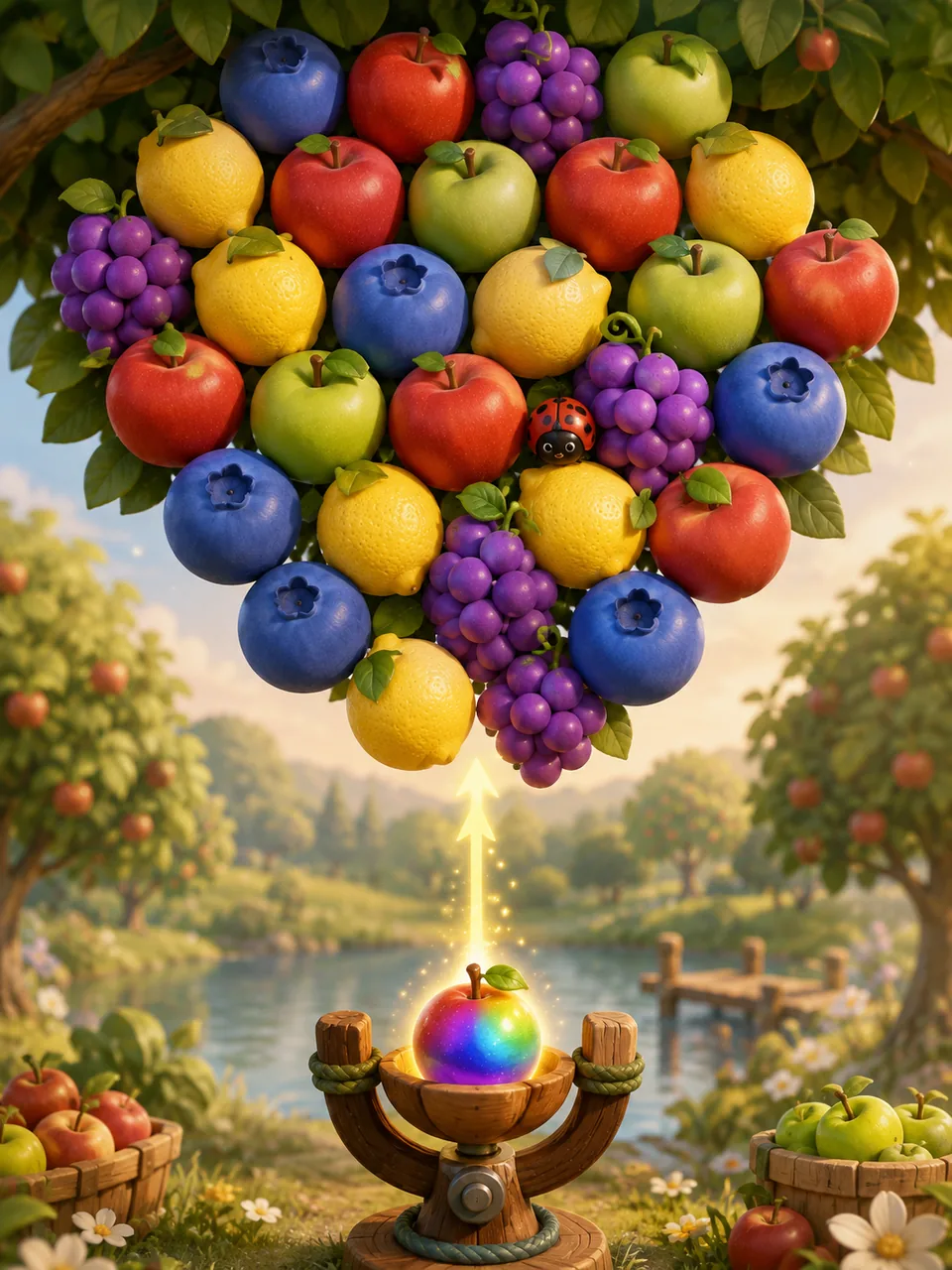
Orb Orchard began with a simple goal: make a fruit shooter that feels precise on a phone. Drag to aim, release to launch, and connect three or more matching fruits. Every shot locks into a fixed hexagonal grid, so the guide line, wall bounce, and final landing stay predictable.
Look for the support fruit
A three-fruit match is useful, but a match holding up a larger branch is much better. Once a group is no longer connected to the top of the orchard, every unsupported fruit drops. I usually scan from the bottom upward and look for a narrow colored connection before choosing a direct match.
Use bank shots for side pockets
The dotted guide reflects from the side walls at the same angle as the real shot. Start with steeper bank shots because their landing point is easier to read. A shallow bounce can reach farther across the board, but it also gives the fruit more chances to touch the wrong cluster.
Save special fruit for a real problem
Rainbow Fruit joins the strongest matching color beside its landing point. Bomb Fruit clears its landing area and can rescue a trapped ladybug immediately. Each level provides only a small number, so I prefer to use them on a blocked pocket or a large hanging branch instead of spending them on the first easy match.
Read the level goal
Levels 1 through 3 teach ordinary clearing. Levels 4 through 6 ask for a specific fruit color. The next groups introduce ladybugs, two-hit ice, vines that open when you match beside them, and tighter shot limits. Level 18 combines the ideas in one final orchard. You do not always need to clear every fruit; the goal at the top of the screen tells you what matters.
Keep a calm shooting rhythm
The next fruit is always visible. Before launching the current one, check what is coming and avoid closing the route it may need. A quick shot can earn a small match, but one patient setup can create the kind of large drop that clears half the board.
Orb Orchard was created and developed by Even Ouyang for Arcade Nibble.