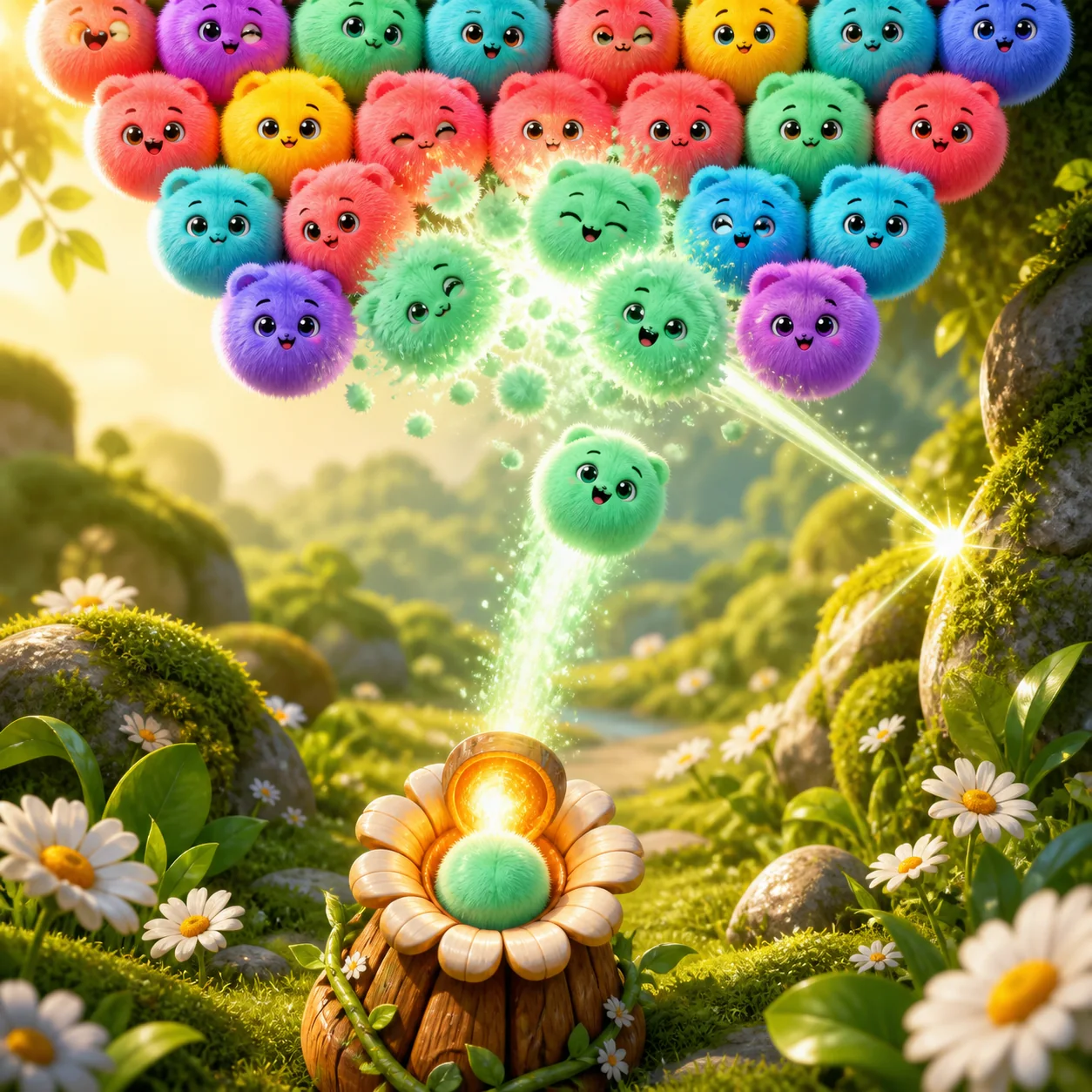
Bubble Bloom looks soft and cheerful, but the strongest moves come from reading how the entire cluster hangs together. Drag to aim, release to launch the current puffling, and connect three or more of the same color. A direct match is useful. A match that removes the support for a larger group is much better.
Aim from the landing point backward
Before I drag the guide line, I decide where the new puffling needs to stop. Then I trace the shot backward toward the launcher. This is especially helpful near the side walls, where a bank shot can reach a pocket that a straight shot cannot.
Look for support colors
A group falls when it is no longer connected to the upper cluster. If several colors hang from one narrow neck, clear that neck first. The falling pufflings create a much larger score burst than a simple three-piece match. This is the main idea behind the harder gardens.
Use the walls on purpose
The wall reflection follows a predictable angle. A shallow bank travels farther across the board; a steeper bank returns toward the same side. I added the guide line to make the first part readable, but you still need to picture where the puffling will fit after the bounce. Leave a little room because the cluster is made of round pieces, not square grid cells.
Do not feed the lowest row
A tempting match near the bottom can leave the cluster closer to the flower line. When two shots are available, prefer the one that clears upward or opens a route to a support color. The late gardens add more colors and stone obstacles, so keeping the center open becomes increasingly important.
Gardens 7 and 8
The final two gardens are designed around hanging drops. Small matches alone are usually too slow. Look for one color holding several branches, bank into it if needed, and let gravity do the scoring. It is okay to spend a shot setting up the next one if the resulting drop will remove a large section.